
Day One (Again)
What Five Days of Actually Paying Attention Taught Me

I’ve had a lot of “day ones.” If you’ve followed along here for any length of time, you know that. This time felt different enough that I wanted to write it down while it’s fresh. Not as advice, just as a record of what I actually did and what happened when I did it.
Monday, June 15th, I decided this was the start of something I’d track properly. Not a vague “getting back at it” but an actual week, logged in real time, with the WHOOP data and the bodyweight and the training notes all in one place so I couldn’t lie to myself about it later.
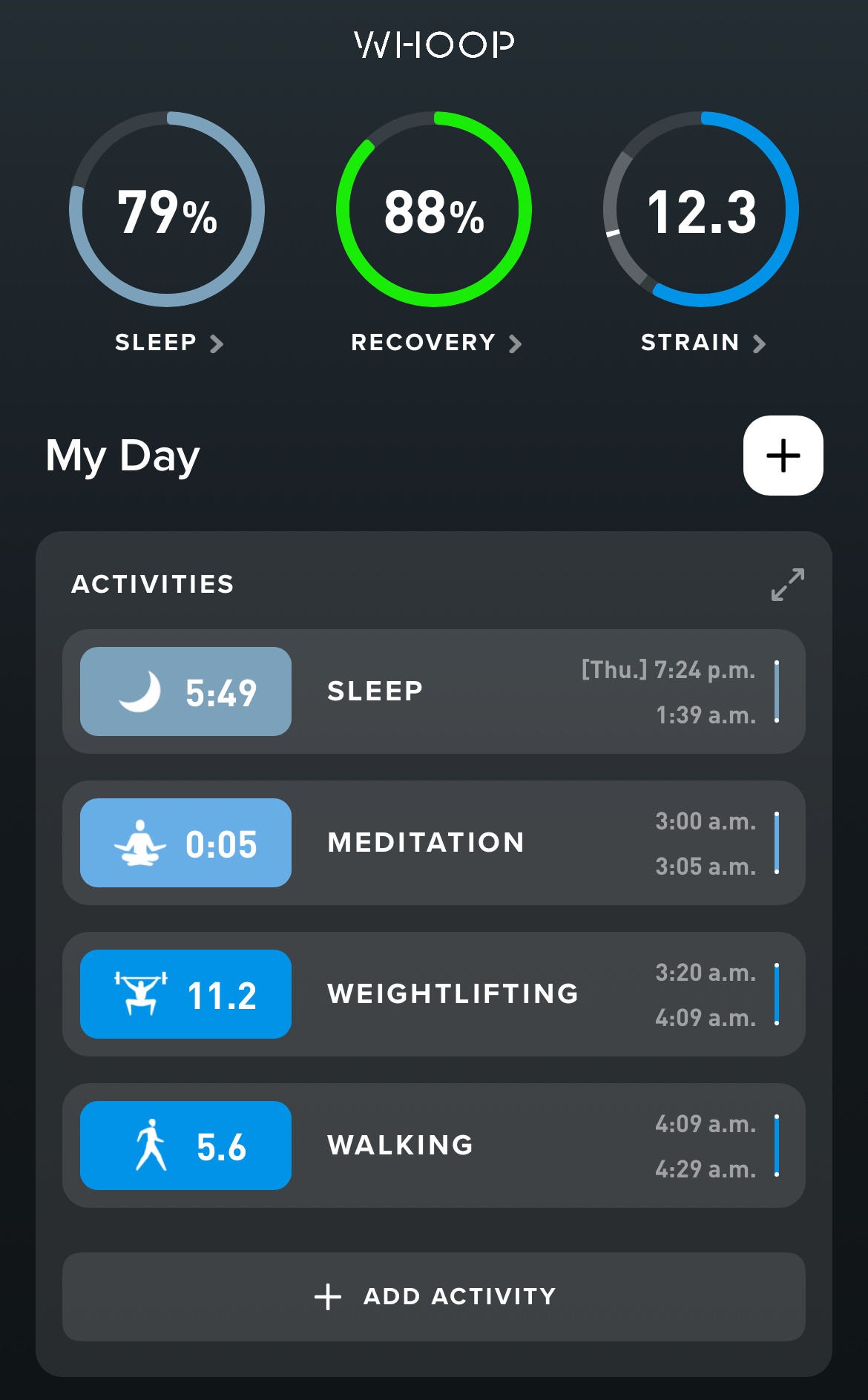
Before I get into it, a quick note for anyone newer here: I wear a WHOOP, which is a wearable that tracks things like heart rate, sleep, and recovery around the clock. I’ll be referencing a few of its metrics throughout this newsletter, so here’s a plain-language primer so none of it feels like jargon.
HRV (Heart Rate Variability): the variation in time between each heartbeat. Sounds backwards, but more variability is generally a good sign as it suggests your nervous system is recovered and able to adapt. Lower HRV tends to show up when you’re fatigued, stressed, or run down.
RHR (Resting Heart Rate): how many times your heart beats per minute at rest. Generally, a lower resting heart rate reflects a more efficient, well-recovered cardiovascular system. It tends to creep up when you’re under-recovered or fighting something off.
Recovery score: WHOOP’s daily rollup of HRV, RHR, sleep, and a few other inputs into a single percentage and its best guess at how ready your body is to take on strain that day.
Strain: a single number representing how much cardiovascular load you put on your body in a day, from a walk to a brutal workout.
VO2 max: a measure of how efficiently your body uses oxygen during exercise. It’s one of the better long-term markers we have for cardiovascular fitness and is tied pretty closely to longevity.
Zone 2: a heart rate training zone — for me, roughly 118-133 BPM — that’s easy enough to sustain for a long time but still builds your aerobic engine. It’s the opposite of going all-out; the whole point is steady and sustainable.
With that out of the way, here’s the honest rundown of the week.
The Numbers
Day One: 173 lbs, HRV 27, resting heart rate 74.
Day Five: 170.8 lbs, HRV 35, resting heart rate 70.
That’s the headline. Down 2.2 pounds, HRV up significantly, resting heart rate back down toward baseline — all signs that, despite a demanding week, my body handled the load and recovered well rather than getting buried by it. I’m not going to pretend I know exactly which lever moved that needle most — the training, the protein timing, the breathwork, probably all of it stacked together. But the trend line is the trend line.
For context on where I’m headed: 155 lbs is the number I’m working toward, not because I’m chasing a look, but because I want to be lighter on a frame that’s been carrying more than it needs to. The bigger goal underneath all of it is longevity is building a body and a set of daily habits that let me show up fully for the next few decades, not just this year. The weight, the VO2 max work, the breathwork, the sleep, none of it is the point on its own. It’s all in service of trying to live in a way that’s more aligned with how I actually want to feel, long after this particular week is over.
What the Week Actually Looked Like
Five training days in a row. Upper body, lower body, a heavy Zone 2 day, upper body again, then a lower body/core/carry day. Mixed in: close to an hour of Zone 2 cardio one day, and intervals on the bike testing my ceiling for something called the Norwegian 4x4 — a well-known VO2 max protocol that involves four rounds of four minutes at a hard effort (85-95% of max heart rate) with short recovery in between. I’m not ready for the real version yet, so I’m building toward it with shorter, more manageable intervals first.
The mornings had a rhythm to them I didn’t expect to stick: up early, dogs out, protein and water first thing, light exposure, Wim Hof breathing (a structured breathwork practice involving cycles of deep breathing and breath holds, popularized by the guy whose name it carries… proponents use it for stress regulation and as a kind of controlled stress-exposure practice). Some days I added a longer escalating box breath practice on top of that… I pushed the hold times further than I expected one morning and actually felt that CO2-buildup sensation hit before I backed off. Good reminder that the breath has its own feedback loop if you’re willing to listen to it.
By day five, the fatigue was real. Five days straight, early wake-ups, real training volume and my body let me know it. Woke up a little stuffy, dry eyes, and for a minute I wondered if I was catching something. Turned out my humidifier had run dry overnight, which was a relief, but it was also a good check-in moment: is this illness, or is this just five days of asking a lot of myself? Worth asking the question either way.
What’s Next
I’m writing this knowing my week isn’t quite over. Tomorrow is an easy Zone 2 walk on the treadmill instead of the outdoor hike I’d hoped for as the forecast had other plans. Sunday is a full day off, no negotiation.
That’s not me backing off the plan. That’s the plan. Five days on, then give the system a chance to actually absorb what I asked it to do this week.
Week Two: What I’m Adding
A few intentional shifts heading into next week.
Progressive overload. Simple in concept, easy to neglect in practice: each week, I want to be adding a little more weight to the lifts where I can… same reps, same rest periods, just incrementally more load. It’s the actual driver of strength and muscle adaptation over time. Without it, you can train hard forever and just be treading water. I tracked exact sets, reps, and rest periods this week specifically so I have a baseline to push against.
Sauna, three times a week. Heat exposure has a growing body of research behind it showing cardiovascular benefits that look similar in some ways to aerobic exercise, plus some early evidence around heat shock proteins and cellular stress resilience. For me, it’s also just a forcing function for stillness. Twenty minutes where I can’t be on my phone is its own kind of recovery.
Slow exhale breathing before bed, for HRV. This is the new one I want to explain, because the “why” matters here. My Wim Hof practice in the mornings is intentionally a stress stimulus with fast breathing, breath holds, a controlled jolt to the system that I then recover from. It’s great for what it does, but it’s not built to calm things down. So I’m adding a short practice before bed that’s the opposite: a few minutes of breathing where the exhale is noticeably longer than the inhale — something like a 4-count in, 6 to 8-count out. A longer exhale directly stimulates the vagus nerve, which is the main highway for your parasympathetic (“rest and digest”) nervous system. Over time, this kind of practice is one of the more consistently-supported ways to nudge HRV upward, separate from anything I’m doing earlier in the day. Sauna and Wim Hof are both stress I’m asking my body to adapt to; this is the counterbalance, actively practicing the “down-shift” rather than just hoping it happens on its own once my head hits the pillow.
What I’m Taking From This
I don’t have a tidy lesson yet. One week isn’t a pattern, it’s a data point. But the early signal — feeling strong through the sessions, the HRV trend moving the right direction, the scale moving the right direction is enough to make me want to do this again next week, and the week after that.
The real test isn’t this week. It’s whether I’m still doing this in a month, and whether the choices I’m making now actually add up to the longer, more aligned life I’m after and not just a number on the scale on the way to 155, but the version of me that’s still strong, still capable, still showing up decades from now.
More next Saturday.
I just did the opposite. I took my whoop off after having it on for the past 3 years. I found myself looking for excuses to “recover”. I had a come to Jesus talk with myself and took it off. The only metrics I’m looking at the rest of 2026 are “am I stronger” and did my muscle mass improve on my monthly in body scan.
I am always great on week one. It’s the weeks after that I struggle with.